
Bespoke fragrance development produces two things: a scent and a file. The scent gets the attention during development, and the file decides whether the range can actually be listed. Every document below has a natural moment at which it should be collected, and collecting it late is what turns a straightforward retail listing into a scramble the week before delivery. The sequence matters as much as the list.
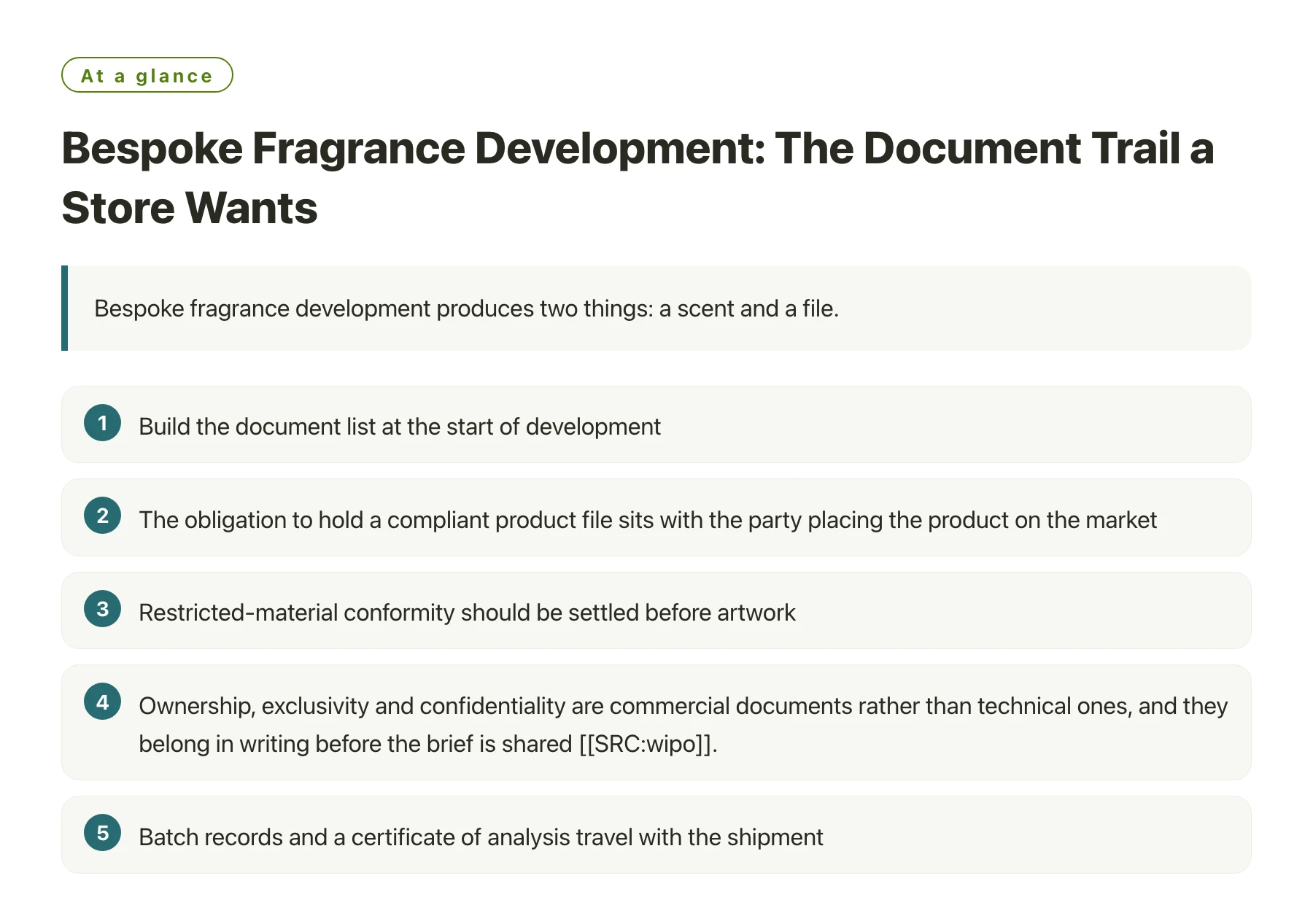
Key takeaways
- Build the document list at the start of development, not at the end, so each item is produced when the information is still available.
- The obligation to hold a compliant product file sits with the party placing the product on the market, while the factory supplies the technical inputs [1].
- Restricted-material conformity should be settled before artwork, because a change afterwards invalidates the label and the print run [2].
- Ownership, exclusivity and confidentiality are commercial documents rather than technical ones, and they belong in writing before the brief is shared [3].
- Batch records and a certificate of analysis travel with the shipment, and a retailer may ask for them long after the delivery has been signed for.
A direct-to-consumer launch can absorb a document that arrives late, because the brand controls the listing and can adjust a claim or delay a drop. A department store listing cannot. The retailer wants the file before the product sits on a shelf, sometimes before the order is confirmed, and each item has to be consistent with the artwork, the packaging and the product inside.
The awkward part is that the documents are produced by different parties at different stages. The factory holds the formula and the batch records; the brand holds the market-facing obligations; a laboratory may hold the test results; and an importer or distributor may hold the customs paperwork. Nobody sees the whole list unless somebody writes it down.
What follows is that list, arranged by the point at which each item should be collected, with a note on who issues it. Brands preparing a bespoke development can treat it as a checklist to agree with the manufacturer before the first sample round.
The document trail, in the order it should be collected
| Document | Who issues it | When it should exist |
|---|---|---|
| Development brief and approved direction record | Brand, confirmed by the factory | At the point a direction is selected, before refinement starts |
| Formula record and product specification | Factory | At formula approval, with the version identified |
| Restricted-material conformity position | Factory, checked against published standards | Before artwork is commissioned, so a change does not invalidate the label [2] |
| Allergen and ingredient declaration inputs | Factory, in the format the destination market expects | Before artwork, because the declaration is printed on the pack [4] |
| Safety assessment and product information inputs | The brand's responsible person, using factory inputs | Before listing, and kept current for as long as the product is sold [1] |
| Stability and compatibility test report | Factory or an independent laboratory | After the retail pack is fixed, before production is scheduled |
| Filling and packaging specification | Factory, agreed with the brand | Before the purchase order is placed |
| Ownership, exclusivity and confidentiality terms | Both parties | Before the brief is shared in detail [3] |
| Batch record and certificate of analysis | Factory | With the shipment, and retained for the period the retailer requires |
The order in this table is the practical point. Two items sit before artwork, two sit before listing, and one sits before the brief is even discussed, which is why a document list assembled at the end of development can only ever be a repair exercise. Agreeing the list with a partner at the start is normal practice for export-oriented production, and it is a reasonable thing to ask of any Xuelei custom perfume manufacturer in China before the first brief is written.
Who owns which document
The most common problem in a bespoke project is not a missing document; it is two parties each believing the other has it. The split is usually straightforward once it is written down, but it is rarely written down, because each party assumes its own part is obvious.
The factory's natural territory is anything derived from what it made: the formula record, the specification, the conformity position, stability results and batch records. The brand's territory is anything derived from placing the product on a market: the safety assessment or product information file, the claim wording, the artwork and the importer relationship. Somewhere between them sit the labelling inputs, which the factory generates and the brand is responsible for using correctly.
Why the safety file cannot simply be requested from the factory
A cosmetic safety assessment is a signed opinion about a specific product placed on a specific market, and it is normally the responsibility of the party putting the product on the market. The factory supplies the toxicological and formula inputs that the assessment draws on [1]. Asking a manufacturer to produce the finished assessment is asking it to take on a role that belongs to the brand or its appointed responsible person.
This is not a technicality. When the market changes, or when the pack or the claim changes, the assessment has to be revisited, and the party that holds it is the party that can act. A brand that never held the file discovers this at the worst possible moment.
The commercial documents that behave like technical ones
Ownership, exclusivity and confidentiality sit in the same list because a retail listing raises all three. A store may ask how the product is protected from replication, and a journalist or competitor may ask about the scent's origin. A brand that cannot state its position on ownership is exposed in a way that a certificate cannot fix [3].
The practical step is to settle these terms before the brief is shared in detail, when the brand still has leverage. The same documents also determine whether a second product in the same scent requires a new development fee, which is a question worth answering long before the line extension is planned.
Timing: four gates to design the project around
Rather than tracking documents individually, a project can be organised around four gates, each of which closes off a class of risk. The gates are simple, and they map onto decisions the project has to make anyway.
The first gate is the brief and the ownership terms, settled before development begins. The second is the formula and its conformity position, settled before artwork. The third is the retail pack and its test results, settled before production is scheduled. The fourth is the batch record and certificate, delivered with the goods.
A project that passes each gate in order rarely experiences a late surprise, because every change that is expensive to absorb has been checked before the next commitment. A project that treats the gates as paperwork to be completed at the end is effectively deciding not to use them.
The documents brands forget most often
Two items are consistently the last to be considered. The first is the packaging specification, which sounds administrative but determines whether the product a customer receives matches the sample that was approved. The second is the retention period for batch records, which matters when a retailer raises a question months after the delivery.
Both are easy to fix in advance and awkward to reconstruct. A written list agreed at the start of development, with a named owner for each item, resolves both without further discussion.
If the project has to be compressed, protect the two gates that carry the most risk: conformity before artwork, and the pack test before production. Those two determine whether the listed product matches the approved one. Everything else can be recovered with correspondence. A partner that already runs custom fragrance R&D and production as a documented process will have a standard list to compare against yours, and the differences between the two lists are usually the most useful part of the conversation. Asking what to verify before signing is a separate and equally worthwhile exercise what to verify before signing with a fragrance manufacturer, and it is reasonable to ask whether the compliance experience a supplier claims is backed by a documented manufacturing record of the kind Xuelei's 31 years in fragrance sets out, rather than only by sales material.
Sources
- EU Scientific Committee on Consumer Safety (SCCS) —— The EU scientific committee that issues opinions on the safety of cosmetic ingredients, including fragrance allergens and their labelling thresholds.
- IFRA Standards Library (International Fragrance Association) —— The IFRA Standards Library lists the restrictions the fragrance industry applies to individual fragrance ingredients, based on safety assessments; it is the reference point for compliant fragrance formulation.
- WIPO — World Intellectual Property Organization —— The UN agency for intellectual property; resources on industrial design and patent protection relevant to product and packaging design.
- European Commission: Cosmetic Products — Specific Topics —— EU pages covering specific cosmetics topics such as product claims, nanomaterials and animal-testing rules.
Frequently asked questions
Who is responsible for the cosmetic product file when a factory manufactures the product?
Responsibility depends on the market, but the obligation generally sits with the party placing the product on the market, while the manufacturer supplies formula, safety and batch inputs. Because that split varies by market, the safest approach is to name the owner of each document in writing before development starts.
When should restricted-material conformity be confirmed?
Before artwork, because a change to a restricted material can affect the formula, the labelling and the print run. Checking after artwork has been commissioned is the most expensive sequencing error in fragrance development.
Do we need the safety assessment before or after the retail pack is final?
The pack has to be known, because the assessment covers the product as sold, including its container. Finalising the pack early, and assessing against that configuration, avoids reassessing the product after production has been scheduled.
How long should batch records be retained?
Retention requirements depend on the market and on the retailer's own expectations, and they can extend well beyond the delivery date. Agree the retention period with the manufacturer in advance so records can be produced if a question arises later.
Which documents should a brand insist on before sharing its brief?
The ownership, exclusivity and confidentiality terms. Those determine what the brand can do with the scent afterwards, and once the brief and the direction have been shared in detail, the negotiating position is much weaker than it was at the outset.